

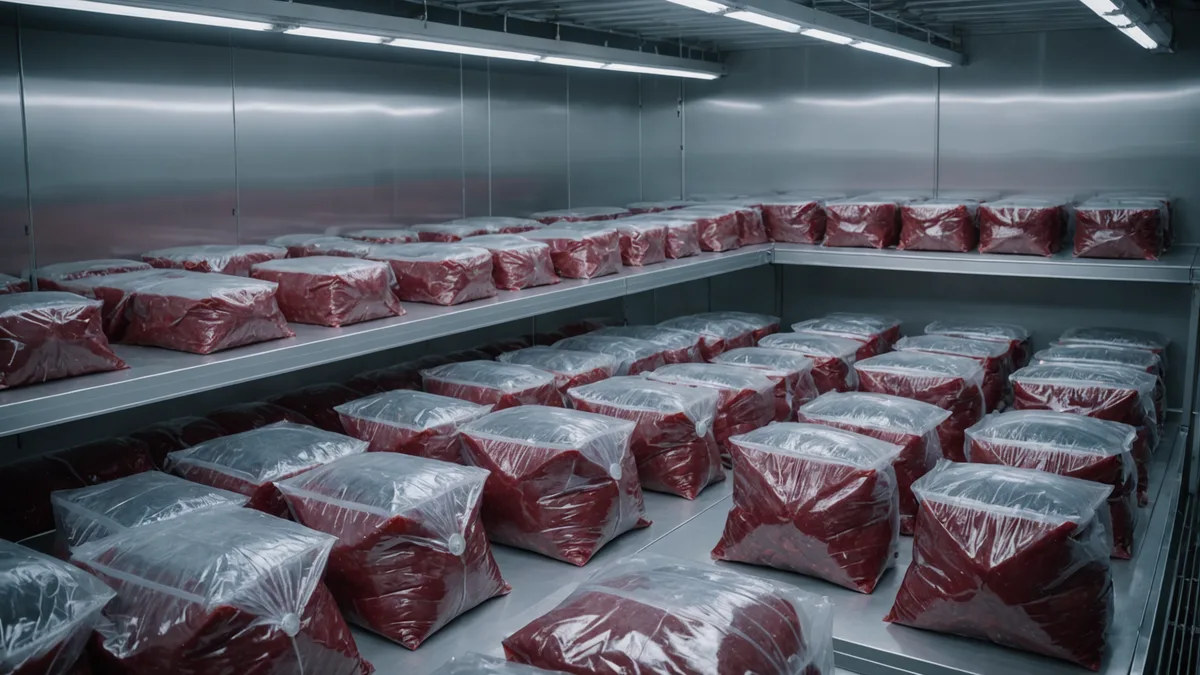
Wet aging gets less attention than dry aging in premium beef circles, partly because it does not produce the same dramatic flavor development and partly because it looks less dramatic. Vacuum-sealed packages in a cold room are not photogenic. But a meaningful portion of premium beef, including much of the premium Hanwoo supply chain, moves through wet aging at some point, and the process is harder to instrument than it looks.
This article is about our current approach to tracking fermentation state in wet-aged beef using CO2 as a proxy signal, and the limitations we have run into building a model around an indirect measurement.
Why wet aging is harder to instrument than dry aging
In dry aging, the product is directly exposed to the chamber environment. Sensors placed in the chamber measure the conditions that actually affect the meat surface and interior. The relationship between sensor readings and enzyme activity is mediated by known physics, primarily temperature, airflow, and humidity effects on the surface.
In wet aging, the product is sealed inside a vacuum package. The chamber conditions still matter, primarily temperature, because enzyme kinetics are temperature-dependent regardless of whether the product is exposed to air. But there is an additional dimension: the fermentation activity of the lactic acid bacteria naturally present in the package environment. Lactobacillus species, primarily Lactobacillus sakei and related organisms that survive and proliferate at cold temperatures, consume sugars in the meat exudate and produce CO2 and organic acids as metabolic products.
This microbial activity is not a contamination problem in a properly managed wet-aging program. It is a normal part of the process. The lactic acid bacteria produce the slight acidic flavor notes characteristic of well-executed wet-aged beef, and they contribute to a mild pH depression in the package environment that further modulates enzyme activity rates. But the rate and extent of this activity varies with the starting microbial load on the product, the storage temperature history, and the composition of the meat exudate.
CO2 as a fermentation state proxy
The CO2 that accumulates inside a wet-aging vacuum package is primarily a product of microbial metabolism. In the absence of atmospheric exchange, CO2 concentration in the package headspace increases as fermentation proceeds. The rate of CO2 accumulation is correlated with lactobacillus metabolic activity, which is in turn correlated with the extent of fermentation and the overall microbial population dynamics in the package.
We cannot measure headspace CO2 directly inside a sealed package without destructive sampling. What we can measure is CO2 in the cold room ambient air. As packages age, small quantities of CO2 migrate through the bag film, and in a closed or semi-closed cold storage environment this creates a measurable ambient CO2 elevation above the background level of around 400 ppm present in outdoor air.
The ambient CO2 reading from a well-placed sensor in a cold room holding wet-aging packages gives us a bulk fermentation state signal. It is not a reading for any individual package. It is a population-average indicator of how far the lactobacillus activity across all packages in the room has progressed. If the ambient CO2 reading is elevated relative to baseline and rising at a rate we expect for the current temperature and aging duration, the fermentation is proceeding normally. If it is flat when we expect rise, or rising faster than expected, those are signals worth investigating.
The calibration problem
The challenge with this approach is that the CO2 signal is affected by multiple variables besides fermentation state. Room ventilation rate, the number of packages present, the surface-area-to-volume ratio of the packages, and the permeability of the packaging film all affect how much CO2 accumulates in ambient air per unit of fermentation activity. These factors vary across operations and even across batches within the same operation as loading changes.
This means we cannot use a single absolute CO2 threshold as a fermentation state indicator. We have to model the expected CO2 accumulation curve for a specific room under specific loading conditions and assess whether the observed curve matches the expected. The model requires calibration data from the specific operation: at minimum, several baseline measurements at known fermentation stages to anchor the expected curve.
In our current implementation, we initialize the model from an operator-provided baseline and update it as the first few batches through the system provide actual CO2 accumulation data. The model becomes more useful after a few cycles, not on day one. This is a limitation we are transparent about. For the first few batches with a new operator, the CO2 signal is primarily a sanity check rather than a precise fermentation indicator.
What CO2 tracking catches that temperature alone misses
The practical value of CO2 monitoring becomes clear in edge cases. A temperature excursion that brings a cold room from 2 degrees to 6 degrees for 24 hours will accelerate both enzyme activity and lactobacillus metabolism. The temperature log alone tells you the excursion happened and lets you estimate the impact on enzyme kinetics. The CO2 signal tells you whether the fermentation also accelerated, which it will if the lactobacillus population is active, and by how much relative to the baseline curve.
A case where temperature looked fine but CO2 was running high prompted us to investigate the packaging supplier on one of our test batches. The film permeability was higher than expected, accelerating gas exchange and causing a faster-than-normal depletion of the package CO2 into the ambient environment. The product was fine, but the anomalous CO2 reading flagged a packaging issue we would not have detected from temperature data alone.
The honest limits of what CO2 tells us
We are not claiming CO2 gives us a complete picture of wet aging fermentation state. It does not. It is a bulk, indirect, room-level signal that correlates with average fermentation progress when calibration conditions are met. It does not tell us about individual package outliers. It does not directly measure lactobacillus cell counts or organic acid concentrations. It does not replace physical product sampling for the most critical quality determinations.
What it does is extend our sensing coverage into the fermentation dimension of wet aging, which temperature alone ignores entirely. For operations where wet aging is a significant part of their program and where previous monitoring has been limited to calendar duration and a single temperature probe, adding CO2 monitoring creates a new information stream at modest incremental cost. Whether the incremental information justifies the instrumentation and calibration effort depends on the scale of the operation and the consistency requirements of their premium beef program.
For Hanwoo programs where the product value is high enough that a poorly fermented batch represents meaningful financial exposure, we think the answer is usually yes. For lower-value mixed programs where wet aging is a short tenderization step rather than a flavor development program, the case is weaker. We try to be honest about that in how we talk to prospective operations about where this part of the system adds value.