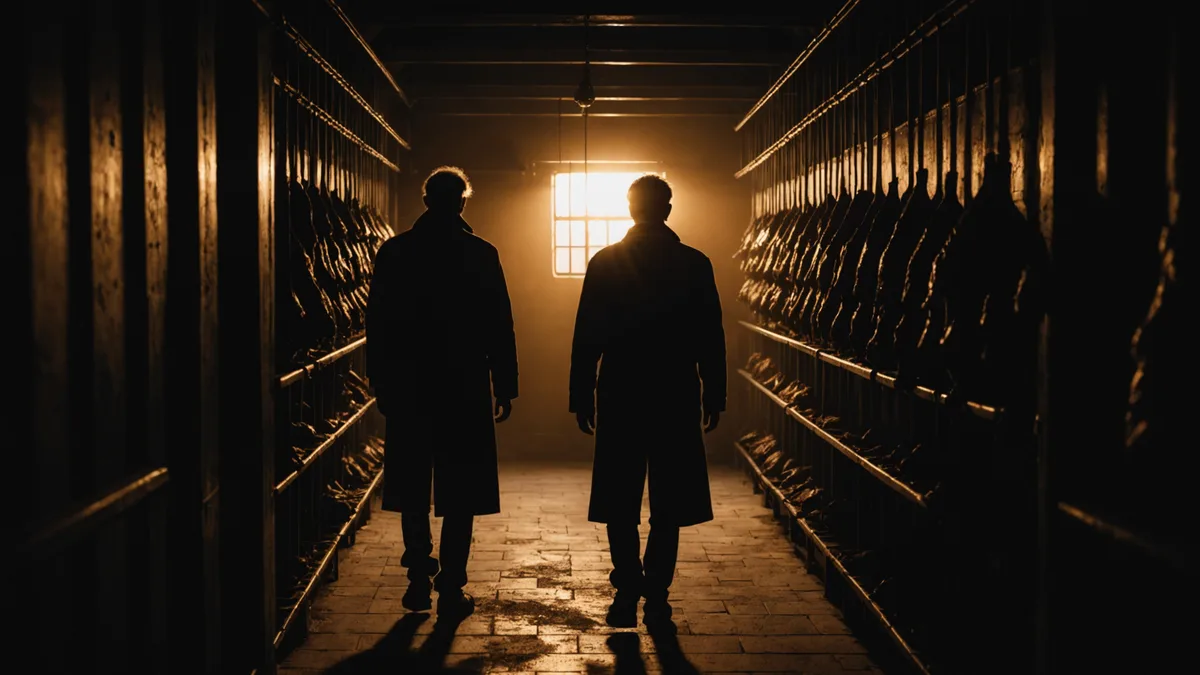


Humidity is the variable in dry aging that people understand least well, and that misunderstanding costs product quality. Operators often focus on temperature as the primary control parameter because temperature is what food safety regulations specify and what their refrigeration unit's controller reports. Humidity runs in the background, managed loosely if at all, and the consequences accumulate over the full aging run before they become visible.
This article is about what humidity control in a dry-aging environment actually requires when you set aside the idea that "roughly 75 to 85 percent" is an acceptable specification.
Why the 5-point band matters at the surface
The surface of a dry-aging beef cut is not a passive observer of the chamber environment. It is an active boundary where moisture migrates outward from the interior, evaporates into the chamber air, and where the pellicle forms. The pellicle, that dark dry crust on properly aged beef, is a natural barrier that protects the underlying muscle from unwanted surface flora while allowing controlled moisture loss.
Pellicle formation requires that the surface dries at a controlled rate. Too fast, and the outer layer desiccates before the protective microbial ecology of the chamber can establish itself. Too slow, and the surface stays moist long enough for unwanted organisms to compete with the desired aging flora.
The difference between 78% and 83% relative humidity is about 5 percentage points in the logged reading, but the effective water activity at the meat surface depends not just on the chamber air humidity but on the airflow velocity across the surface, the temperature gradient between the meat and the chamber air, and the load factor in the chamber. A full chamber at 78% relative humidity will have a different effective surface condition than a half-full chamber at 78%, because the evaporating moisture from all the product raises the localized humidity near each cut, especially in areas with lower airflow.
The refrigeration cycling problem
Most commercial dry-aging chambers use refrigeration units that cycle on and off to maintain temperature. When the compressor runs, the evaporator coil cools below the dew point and strips moisture from the air, dropping humidity. When the compressor is off, humidity slowly rebounds as moisture continues to evaporate from the product and the chamber walls.
This creates a humidity waveform that cycles with the refrigeration. In a poorly designed system, the swing can be 8 to 12 percentage points peak to trough across a single refrigeration cycle. The logged reading, which most chamber controllers report as a time-averaged value or sample at infrequent intervals, obscures this cycling.
The practical consequence is that the meat surface experiences intermittent periods of relatively high and low humidity. If the low period is too low for too long, it can over-desiccate the outer surface before the pellicle has fully developed. If the high period exceeds 85 to 87% during the early aging phase, it creates a window for unwanted mold or bacterial activity.
Managing this requires either a higher-quality refrigeration system with better humidity response, active humidification, or at minimum a control strategy that anticipates the cycling and adjusts setpoints to keep the effective humidity within the target band across the full cycle. You cannot do any of this without high-resolution humidity logging that samples at short enough intervals to see the cycling behavior.
Door openings and recovery time
Every time the chamber door opens, a volume of conditioned air is exchanged with the warmer, potentially more humid or drier ambient air outside. In a commercial aging operation, the door may open dozens of times per day for loading, inspection, and retrieval of finished product.
A single door opening event can shift chamber humidity by 3 to 6 percentage points in a small chamber, and the recovery time depends on the chamber volume, the efficiency of the humidity management system, and the ambient conditions outside. In a Korean summer, the incoming ambient air is both warmer and more humid than chamber setpoint. In winter, it is drier. The same door-opening frequency has different humidity consequences depending on season.
Understanding the recovery profile for a specific chamber under specific loading conditions is necessary to set appropriate alert thresholds. A threshold of "alert if humidity exceeds 84% for more than 30 minutes" has a very different false-positive rate in summer versus winter if you do not account for the different recovery dynamics. Calibrating this correctly requires logging enough door-opening events and recovery curves to build a model of the chamber's specific behavior.
Sensor placement and what the controller probe misses
The humidity sensor that ships with most commercial dry-aging chambers is positioned at a location convenient for the controller, which is often at the air return or near the evaporator unit. This placement reflects the needs of the refrigeration system, not the needs of a precision aging program.
The humidity at the meat surface at different positions in the chamber can vary by 4 to 8 percentage points from the controller sensor reading, depending on chamber geometry, airflow patterns, and product load distribution. The back corners of a chamber, where airflow velocity is typically lower, accumulate more localized moisture and run consistently higher humidity than the measured average. Product hanging near the evaporator unit runs drier and cooler than product in the center.
This spatial variation means that a single humidity target for "the chamber" is an abstraction. In practice you are managing a gradient, and different positions in that gradient produce different outcomes on the product that hangs there. Without mapping the spatial humidity distribution at least once per chamber configuration, you are flying partially blind.
What precision actually costs operationally
We should be direct about the tradeoff here. Tight humidity control in a dry-aging environment is technically demanding and operationally intrusive. It requires higher-quality sensors placed at multiple points, more frequent calibration, and potentially modifications to the airflow design of the chamber. It also requires logging infrastructure and the willingness to act on what the data shows.
Not every operation needs this level of control. A smaller artisan operation running 6 to 10 sides in a purpose-built chamber with controlled ambient conditions and low door-opening frequency can achieve consistent results with less instrumentation, because the variance sources are fewer and smaller. A larger operation running 40 to 80 sides across a shared cold room with variable door traffic and product mix needs more rigorous control to achieve comparable consistency.
What we have found in our own testing is that the highest-value intervention is usually not adding more sensors, but logging at higher frequency with the sensors already present. Most commercial chambers ship with sensors capable of 1-minute sampling intervals. Most controllers are set to log at 15-minute or 30-minute intervals because that was sufficient for the temperature-focused control they were designed for. Increasing the sampling rate on existing sensors costs nothing and immediately reveals the cycling and event response behavior that was previously invisible in the logged data.
That is the first step. Everything else, additional spatial sensors, airflow redesign, active humidification, builds on having a clear picture of the chamber's existing humidity dynamics before intervening to change them.