
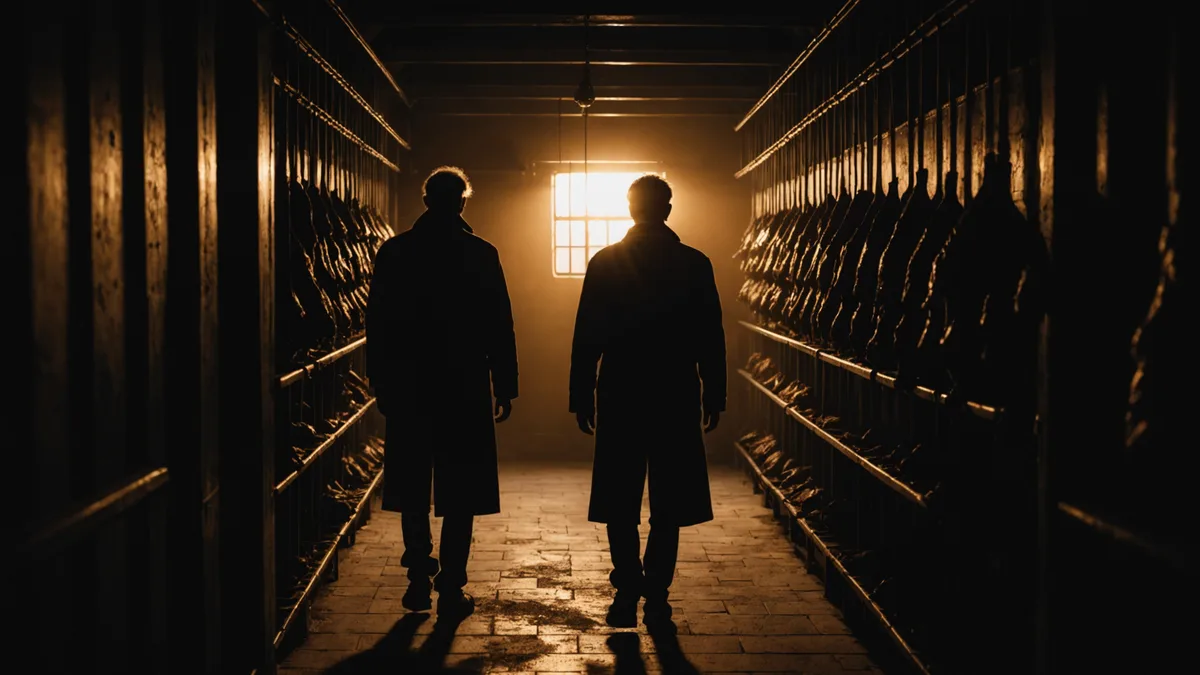
The argument for sensor-based aging control is easy to make on paper. A sensor does not get tired. It does not have an off day. It does not retire and take twenty years of chamber knowledge with it. Every operator who runs a premium beef program knows the problem of knowledge concentration: one person knows how the room smells at day 18, knows what the surface color means at different humidity levels, knows that the batch in the northwest corner always runs two days slow because the refrigeration coil is slightly farther away.
That argument is compelling but incomplete. We spent three days at an aging facility in Icheon in October watching an experienced aging practitioner work, and the visit forced us to confront what sensor data cannot capture, at least not yet.
What the expert actually does
Before we started building anything, we needed to understand what "reading a chamber" means in practice. It is not a single inspection. It is a continuous overlay of signals accumulated across multiple visits per day, over a career of seeing how small deviations compound over time.
The practitioner we observed enters the chamber and does several things simultaneously. The first is a visual sweep across the hanging cuts, reading surface color and crust formation. Not once, not with a meter, but with accumulated reference images from hundreds of previous batches. The crust on a correctly aging loin at day 12 looks different from a crust that developed too fast because humidity was too low in the first three days. Both look "correct" to the naked eye at a glance. They look different to someone who has seen both outcomes through to the plate.
The second is a pressure test on select cuts, a light manual compression at a few points on each hanging piece. Experienced practitioners can detect differences in surface firmness that correspond to pellicle development depth, and they use this as a proxy for how far the tenderization front has progressed from the outside in. There is no sensor in our current array that captures this. Texture depth gradient is not a probe measurement.
The third is smell. The olfactory assessment happens automatically the moment the door opens. The practitioner in Icheon could distinguish, within seconds, between the normal complex aromatics of a healthy aging environment and a very early deviation that no visible sign had yet confirmed. On one of our three days he flagged a section of the chamber that showed slightly elevated surface moisture. Our humidity sensors read within normal range. His nose caught a shift in the fermentation signature that our CO2 probe registered only another four hours later.
The consistency problem at scale
Here is the thing: what the expert does is extraordinary. It is also non-transferable in its full form. The facility in Icheon has been running under this practitioner's care for years. That is the length of time it takes to build the reference library that makes his assessments reliable. When he eventually leaves, the facility will need to rebuild that knowledge through another long apprenticeship, or they will reduce the program to a simpler set of rules that any trained operator can follow, and quality will regress toward the mean.
This is the actual problem we are building against. Not that expert judgment is bad. It is often excellent. The problem is that it cannot scale, it cannot be transmitted, and it breaks catastrophically when the key person is unavailable. Our system does not need to be better than the expert. It needs to be good enough to operate reliably when the expert is not there, and to give the expert better data when they are.
What sensor data captures that intuition misses
To be fair to the data side: there are things sensors do well that intuition does not.
Continuous logging catches slow drift that accumulates below the threshold of conscious perception. If humidity rises by 0.3% per day over a two-week aging run, no expert inspection will catch it until it is already past the point where intervention would have been easy. The sensor log shows it clearly as a line plot, and automated alerting can trigger on day four rather than day twelve.
Sensors also create records. When a batch comes out wrong, the log lets you reconstruct exactly what happened to the chamber environment across the entire aging period. Manual inspection leaves no record. The expert walks away with a memory of what seemed normal. The log tells you that the refrigeration unit cycled off for six hours on night nine because the compressor tripped, and that the temperature at the mid-chamber probe climbed to 7.2 degrees before anyone noticed.
Sensors also operate during the hours between manual inspections. Premium beef programs do not have someone in the chamber at 2 AM. The overnight period is when slow anomalies can develop without any human awareness.
The gap we have not closed yet
The olfactory and tactile signals are the hard ones. We have not built any sensor that reliably captures the aromatic profile of a chamber environment with the resolution needed to replicate what an expert nose detects. Electronic nose technology exists in research contexts but is not robust enough for cold, high-humidity industrial environments at a price point that makes sense for a one-to-four chamber operation.
The texture depth gradient problem is also unsolved. A surface probe captures surface conditions. The interior of a 7-kilogram loin is a different thermal and biochemical environment, and right now we do not have a non-destructive way to assess how far the enzyme activity front has progressed toward the center.
We are not going to claim these gaps do not matter. For the highest-end programs, where the difference between a good outcome and an exceptional one depends on reading signals that our current sensor suite cannot capture, the expert still has an edge. We are honest about that. What we can offer is a more reliable floor: consistent, logged, alerting-enabled coverage of the parameters we can measure, which catches most of the failure modes that produce batches significantly below target.
Where we are taking the model next
The Icheon visit changed how we think about model validation. We came away with a clearer sense that our endpoint prediction needs to be calibrated not just against Warner-Bratzler shear force measurements on finished product, but against the practitioner's real-time assessments during the aging run. We want to know not just whether our endpoint call matches the final texture measurement, but whether the daily trajectory of our model's prediction matches the practitioner's read of where the batch is.
If the expert says on day 14 that this batch is running two days slow, our model should be saying the same thing. If it is not, there is a signal the model is missing. Understanding the systematic divergences between expert assessment and sensor-derived prediction is how we close the gap, one signal at a time.
The three-day visit was valuable precisely because it told us where we are not yet competing and where we are. Knowing the boundary is the prerequisite for extending it.